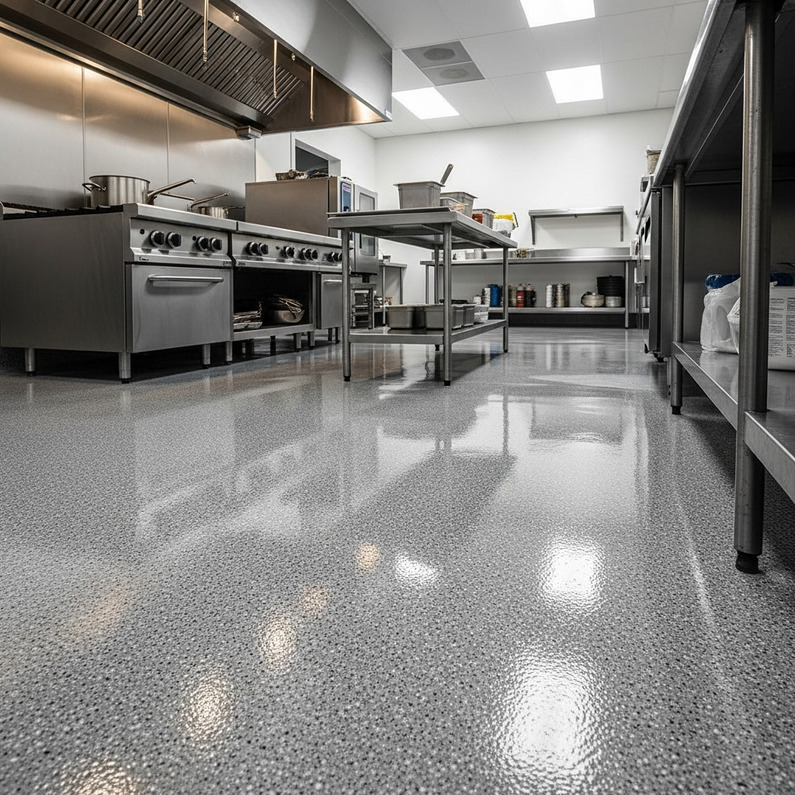
The best epoxy for restaurant floors needs to do more than just look good. It has to handle grease, constant cleaning, heavy foot traffic, dropped equipment, and health department scrutiny without chipping, staining, or becoming a slip hazard. This guide covers which coating systems actually work in food service environments, what to look for before you buy or hire, and how to avoid the costly mistake of choosing the wrong product for one of the most demanding floors in any building.
Why Restaurant Floors Are Harder to Coat Than Most
A restaurant floor deals with a combination of stresses that most other commercial spaces never see. Hot grease lands on it daily. Cleaning chemicals get mopped across it multiple times a shift. Staff walk on it for hours at a stretch, often in wet conditions. Deliveries roll across it. Sheet pans and heavy pots get dropped on it.
Standard epoxy can handle several of those things. But a restaurant environment demands a system that handles all of them simultaneously, accounts for slip risk when wet, resists the specific chemicals used in commercial kitchen cleaners, and can be brought back into service quickly since most kitchens cannot afford long shutdowns.
That combination of requirements narrows the field considerably and changes which products and systems make the cut.
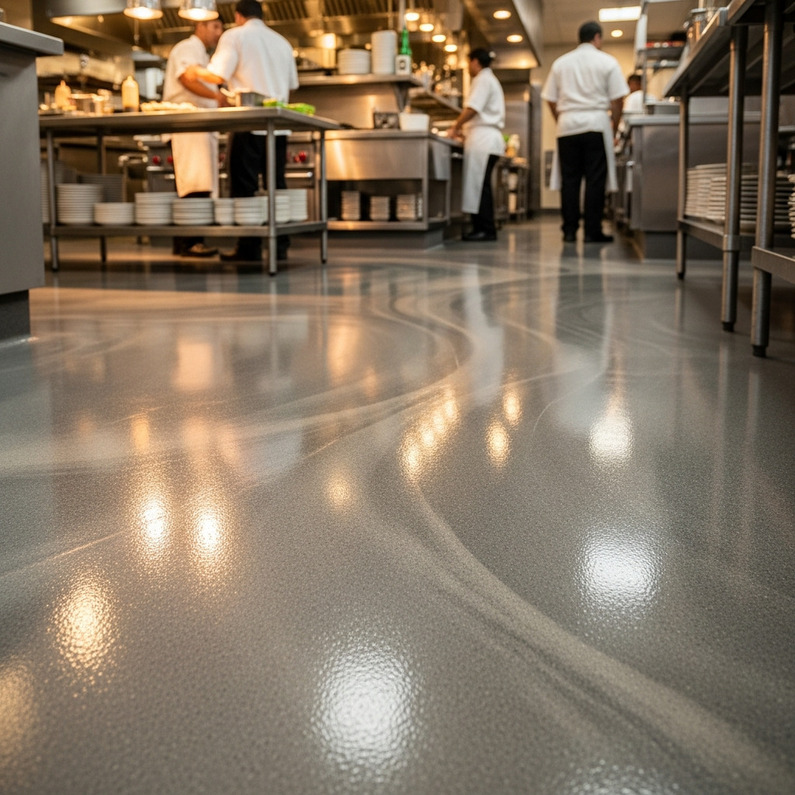
What Makes an Epoxy System Work in a Restaurant?
Not all epoxy products are built the same. The formulation, thickness, topcoat type, and anti-slip additives all determine whether a system holds up in a food service setting or starts failing within a year.
100% Solids Epoxy
Water-based and solvent-based epoxy products contain a percentage of material that evaporates during curing, which means the final coating is thinner than what you applied. 100% solids epoxy does not have that problem. Every bit of material stays in the floor, which means a thicker, denser, more durable surface. For a commercial kitchen, this is the baseline standard. Anything thinner will wear through too quickly under the foot traffic and cleaning frequency a restaurant demands.
Chemical Resistance Rating
Commercial kitchen cleaners are aggressive. Degreasers, sanitizers, and acid-based descalers can eat through coatings not rated for chemical exposure. Before committing to any system, check the chemical resistance specs. You specifically want resistance to alkalis, which covers most degreasers, and mild acids for descaling products. A coating that cannot handle those will start breaking down at the surface within months.
Anti-Slip Aggregate
A smooth epoxy topcoat gets dangerously slippery when grease or water hits it. In a restaurant kitchen that is a liability issue, not just a comfort one. Many systems address this with an aggregate, such as aluminum oxide or quartz sand, broadcast into the wet topcoat before it cures. The aggregate level can be adjusted to balance safety with how easy the floor is to mop clean. Slip-resistant options are available with Northern Arizona Epoxy systems.
Seamless, Non-Porous Finish
Grout lines and seams trap food particles, grease, and bacteria. A properly installed epoxy system is seamless from wall to wall, which makes it far easier to clean to health department standards and eliminates the hiding spots that tile grout creates. This is one of the biggest practical advantages epoxy has over tile in commercial kitchens.
Epoxy vs. Polyaspartic in a Restaurant Setting
Standard epoxy is the most common choice for restaurant floors, but polyaspartic coatings are becoming increasingly popular in food service settings because of their faster cure times and stronger UV stability. For spaces that see sunlight, like a restaurant with large windows or a covered outdoor area, polyaspartic holds its color better over time. Learn more about how polyaspartic performs as a standalone system with a look at polyaspartic floor coatings.
The real advantage of polyaspartic in a restaurant context is speed. A kitchen that needs to close for floor work loses revenue every hour it is down. Polyaspartic can cure fast enough for a full installation to happen overnight in many cases, which means the kitchen can be back in service the next morning. That kind of turnaround is very difficult to achieve with standard epoxy.
Many contractors now use a hybrid approach: 100% solids epoxy as the base coat for thickness and chemical resistance, with a polyaspartic topcoat for fast cure and UV stability. For a restaurant, that combination often delivers the best of both systems.
Restaurant Floor Coating Options Compared
Here is how the most common coating systems stack up against the specific demands of a food service environment:
| Coating System | Cure Time | Slip Resistance | Chemical Resistance | Ease of Cleaning | Best For |
|---|---|---|---|---|---|
| 100% Solids Epoxy | 24 to 72 hrs | Customizable | Very High | Excellent | Kitchens, prep areas, storage |
| Epoxy + Polyaspartic Topcoat | 6 to 12 hrs | Customizable | Very High | Excellent | Full restaurant, fast turnaround |
| Polyaspartic Only | 2 to 6 hrs | Customizable | High | Excellent | Dining areas, fast re-open needs |
| Water-Based Epoxy | 12 to 24 hrs | Limited | Moderate | Good | Light-duty use only |
| Quarry Tile | N/A | Good | High | Difficult (grout lines) | Traditional kitchens |
| Vinyl Sheet Flooring | N/A | Moderate | Moderate | Good | Low-traffic food service |
For a full overview of what professional epoxy systems cover in terms of products and build options, epoxy floor systems breaks down the full range available.
What the Installation Process Looks Like for a Restaurant Floor
The process for a restaurant floor follows the same fundamental steps as any epoxy installation, but the stakes are higher because of health code requirements and the tight turnaround window most operators need.
Surface Preparation
Concrete in a commercial kitchen often has years of grease contamination worked into the surface. Standard grinding alone does not always remove it. A thorough degreasing treatment before mechanical prep is often necessary to make sure the epoxy bonds correctly. Any concrete that has soaked up enough grease to affect adhesion may need additional prep passes or a specialized primer.
Crack and Joint Repair
Cracks and control joints get filled and addressed before coating begins. In a kitchen environment, any gap in the floor surface becomes a hygiene problem, so getting the substrate as smooth and sealed as possible before the coating goes down is especially important.
Primer and Base Coat
The primer penetrates the prepared concrete and sets up the bonding layer. The base coat follows, and this is where the bulk of the coating thickness gets built. For kitchens, contractors often apply the base coat at a heavier mil thickness to compensate for the aggressive wear the floor will see.
Slip-Resistant Options and Topcoat
On systems that include a slip-resistant option, aggregate goes into the wet topcoat before it cures. The topcoat then locks the aggregate in place and provides the final layer of chemical and abrasion resistance. Getting the aggregate density right is a judgment call that experienced installers handle well; too little and the floor is still slippery, too much and it becomes harder to mop clean.
Cure and Inspection
Once the topcoat is down, the cure window begins. This is the period when the floor is most vulnerable, so keeping the space clear of foot traffic and debris matters. A final inspection checks for any thin spots, missed areas, or surface defects before the kitchen reopens. Contractors familiar with restaurant work in Northern Arizona, like those listed on the epoxy flooring contractors in Prescott page, understand the specific prep and timing requirements these projects demand.
Front of House vs. Back of House: Different Floors, Different Priorities
The kitchen and the dining room have different needs, and treating them as the same flooring project is a mistake.
Back of house, meaning the kitchen, prep areas, and dishwashing stations, needs the most aggressive anti-slip treatment, the highest chemical resistance, and the thickest coating build. Appearance is secondary to function and cleanability.
Front of house is the opposite. The dining room, bar area, and entryways are where the floor needs to look sharp. A decorative flake or chip system works well here because it looks polished and professional, and slip-resistant options are available. For examples of how chip systems look in real installations, epoxy chip floor systems in Sedona, AZ shows how that approach comes together aesthetically.
Running the same product throughout simplifies the installation, but specifying the system based on where it will be used gives you better performance in both zones.
What Does a Restaurant Epoxy Floor Cost?
Costs vary based on the size of the space, the condition of the existing concrete, and the system being installed. Here is a general breakdown for food service environments:
| Space Type | Typical Square Footage | Estimated Cost Range |
|---|---|---|
| Small cafe or food counter | 300 to 600 sq ft | $1,200 to $6,000 |
| Mid-size restaurant kitchen | 600 to 1,200 sq ft | $2,400 to $12,000 |
| Full restaurant (FOH + BOH) | 1,500 to 3,000 sq ft | $6,000 to $30,000 |
| Commercial kitchen (standalone) | 1,000 to 2,500 sq ft | $4,000 to $25,000 |
| Bar or brewery floor | 800 to 2,000 sq ft | $3,200 to $20,000 |
These figures reflect professional installation with proper prep. Kitchens with grease-saturated concrete, previous coatings that need removal, or complex layouts sit at the higher end. To see how these systems get installed in real commercial spaces in the region, epoxy floor installations in Sedona, AZ has examples worth reviewing.
Health Code Considerations for Restaurant Floors
Most local health codes require restaurant floors to be smooth, non-absorbent, easily cleanable, and in good repair. Epoxy checks all of those boxes when installed correctly. The seamless surface has no grout lines or seams to trap contamination, the non-porous finish does not absorb grease or moisture, and a quality topcoat can handle repeated exposure to the sanitizing chemicals inspectors expect operators to use.
One thing to confirm with your installer is whether the specific products being used are NSF-compliant or approved for food service environments. Not all epoxy formulations carry that designation, and in some jurisdictions it matters for passing inspection. A contractor with commercial kitchen experience will already know which products meet those standards.
Frequently Asked Questions About the Best Epoxy for Restaurant Floors