
When it comes to polyaspartic vs epoxy floor coating, both systems protect concrete and look great, but they behave differently enough that choosing the wrong one can cost you time, money, or both. This guide breaks down how each system works, where one outperforms the other, and how to figure out which direction makes sense for your specific project.
What Is Epoxy and How Does It Work?
Epoxy is a two-part coating system made from a resin and a hardener. When the two components get mixed and applied to prepared concrete, a chemical reaction occurs that creates an extremely hard, bonded surface. The result is a floor that resists stains, impacts, and moisture far better than paint or basic sealers.
Epoxy has been used in commercial and industrial settings for decades, and it has a long track record in garages, warehouses, and manufacturing facilities. It is available in a wide range of colors and finishes, and it pairs well with decorative flake or quartz broadcasts. For a deeper look at what epoxy systems cover, check out epoxy floor systems to see the full range of options.
The main tradeoff with epoxy is time. It cures slowly, which means the space needs to be out of service for longer. It is also more sensitive to temperature and humidity during installation, and it can yellow over time when exposed to UV light.
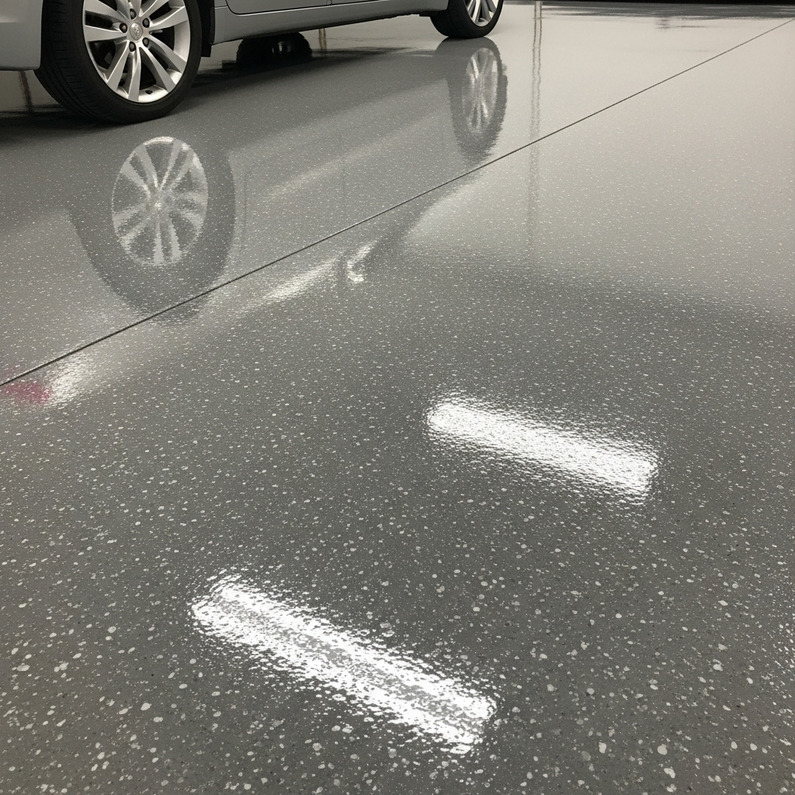
What Is Polyaspartic and How Is It Different?
Polyaspartic is a newer coating technology that falls under the polyurea family. Like epoxy, it is a two-part system, but the chemistry works differently. Polyaspartic cures much faster, sometimes in just a few hours, which makes same-day installations possible.
It is also more UV stable than standard epoxy, which means it resists yellowing and color fade when exposed to sunlight. That makes it a better choice for spaces with skylights, large windows, or direct sun exposure. If you want to understand how polyaspartic performs specifically as a standalone system, the overview of polyaspartic floor coatings covers the key details.
Because it cures so fast, polyaspartic can also be applied in a wider range of temperatures than epoxy, which matters a lot in climates like Northern Arizona where job site conditions vary throughout the year.
Polyaspartic vs Epoxy Floor Coating: A Side-by-Side Comparison
Here is a direct comparison of how these two systems stack up across the factors that matter most:
| Factor | Epoxy | Polyaspartic |
|---|---|---|
| Cure Time | 24 to 72 hours | 2 to 6 hours |
| Full Hardness | 5 to 7 days | 24 hours |
| UV Stability | Low (can yellow) | High (color stable) |
| Application Temp Range | 50 to 90 degrees F | 0 to 120 degrees F |
| Working Time for Installer | Longer (more forgiving) | Short (requires experience) |
| Abrasion Resistance | Very High | Very High |
| Chemical Resistance | Very High | High |
| Typical Cost (per sq ft) | $3 to $12 | $5 to $16 |
| Coat Thickness | Thicker builds possible | Thinner per coat |
| Best Use Cases | Garages, warehouses, basements | Showrooms, retail, fast-turnaround jobs |
For projects anywhere in the region, the team at Northern Arizona Epoxy can help you figure out which system fits your specific space and timeline.
Where Epoxy Has the Edge
Thicker Builds and Heavy Industrial Use
Epoxy systems can be built up in multiple coats to create a thicker overall floor. That extra thickness adds impact resistance, which matters in environments with heavy equipment, dropped tools, or high mechanical stress. For very demanding industrial applications, epoxy is still often the go-to base system.
Chemical Resistance
Standard epoxy holds up extremely well against harsh chemicals, oils, and solvents. Auto shops, manufacturing floors, and chemical storage areas tend to favor epoxy for this reason. While polyaspartic also has decent chemical resistance, epoxy has a longer track record in the most demanding environments.
Cost on Larger Projects
Epoxy materials tend to cost less per square foot than polyaspartic. On a large warehouse floor or a big commercial job, that difference adds up. If the timeline allows for the longer cure, epoxy can be the more budget-friendly path on high-square-footage work.
Where Polyaspartic Has the Edge
Fast Turnaround
This is the biggest selling point. A polyaspartic floor can be installed and returned to service in a single day. For a business that cannot afford to shut down for two or three days, or a homeowner who needs the garage back fast, that speed is a significant advantage.
UV Resistance and Color Stability
Epoxy yellows when exposed to sunlight over time. Polyaspartic does not. Any space with significant natural light, whether a showroom, a gym, or a sunlit garage, will hold its color much longer with a polyaspartic topcoat. This is one reason many installers use epoxy as the base and polyaspartic as the finishing layer. To see how this plays out in real installations in the area, take a look at epoxy floor installations in Sedona, AZ for some examples of how these systems get applied in practice.
Temperature Flexibility
Epoxy has a narrow application window. If it is too cold or too hot, the chemistry does not work correctly and the coating can fail. Polyaspartic handles a much wider temperature range, which gives contractors more flexibility in scheduling and reduces the risk of weather-related installation problems.